
Wardrobe
How to build a capsule wardrobe from one piece
A capsule wardrobe does not start with a shopping list. It starts with one thing you already wear a lot and like, and works outwards. Here is how to choose that piece, pick the neutrals around it and test whether the result actually works.
How do you choose the anchor piece for a capsule wardrobe?
The anchor is the piece you reach for without thinking. It should fit well, suit your life and feel like you. Look through your wardrobe and note what you wear every week, not what you wear on special occasions. Dark straight-leg jeans, a well-cut blazer, a plain knit or a good pair of boots are typical candidates.
Three qualities make a good anchor. First, a neutral or near-neutral colour, so it pairs with much of what you own. Second, a shape that is neither extreme nor very trendy, so it will still work in several years. Third, a fabric you can wear in more than one season. Dark denim satisfies all three, which is why it is the example used below.
If your favourite piece is bold, such as a printed shirt or a bright coat, it can still work as an anchor, but treat it as the accent and build a neutral base around it instead.
Which neutrals should you choose around it?
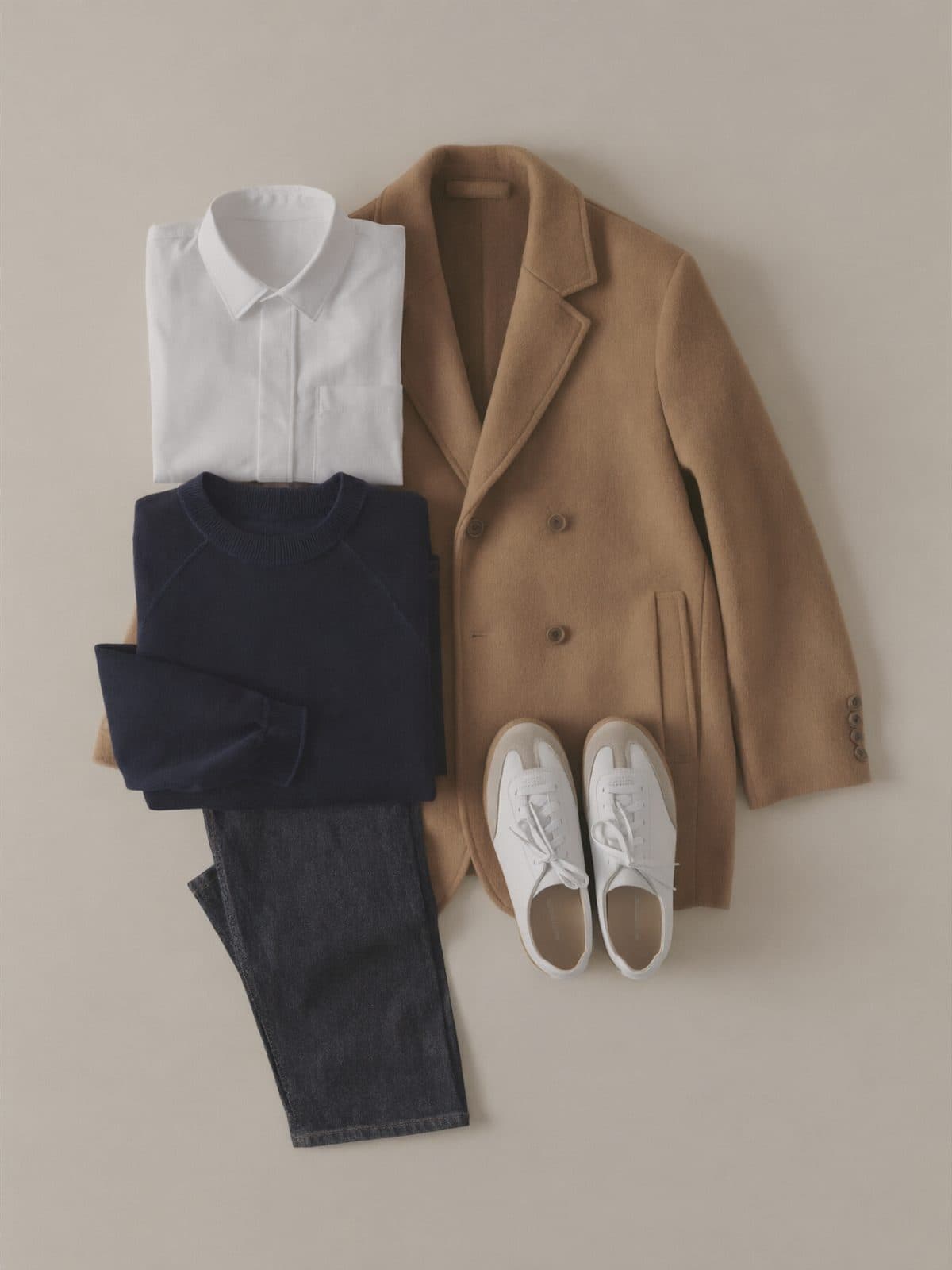
Look at the anchor first. Dark indigo jeans are cool, deep and plain, so they pair with both warm and cool neutrals. A good starting palette is white, navy and camel, with grey as a spare. White provides light contrast, navy provides a tonal link with the denim, and camel provides warmth.
Keep the palette to two or three neutrals, plus the anchor. More than that and the pieces stop combining easily. Make sure the neutrals differ in value: one light, one mid, one dark. This is what lets the same set of clothes produce different moods.
Choose one accent family if you want colour, and keep it simple. Olive, rust or burgundy all pair well with indigo and camel. Pick a single hue rather than three, so any new piece you buy works with everything.
How many pieces does a capsule wardrobe need?
There is no magic number. A capsule of about a dozen pieces, not counting underwear and sportswear, is a reasonable guide for a single season, but your climate, job and habits matter more than a count. The real test is whether each item works in at least three different outfits.
A useful structure is a few tops, a couple of knits, two or three bottoms, one or two layers and two or three pairs of shoes. In the example below, that is dark jeans, a white shirt, a navy sweater, a camel coat, white sneakers and a few supporting items such as tailored trousers, a grey T-shirt, leather boots, and a leather belt.
Resist adding pieces just to reach a number. If a new item does not work with at least three things you already own, it is probably not a capsule piece.
What does a worked example look like?
Take dark straight-leg jeans as the anchor. Add a crisp white shirt, a navy crew-neck sweater, a camel wool coat and minimal white sneakers. That is five pieces, and they already produce a number of outfits: shirt and sneakers for a clean everyday look, sweater and coat for cold days, shirt under sweater for the office.
Next, fill the obvious gaps. A second bottom, such as charcoal tailored trousers, lets you dress up. A pair of dark brown leather boots extends the shoes into autumn and winter. A grey crew-neck T-shirt and a thin brown belt give you casual options. A scarf in oatmeal wool adds warmth without a new colour.
At that point you have roughly a dozen pieces and enough outfits for a couple of weeks without repeating. Everything shares the same palette, so you can swap items freely. Lay the pieces out and check that each one works in three combinations. If something does not, replace it or drop it.
How do you keep a capsule working over time?
Rotate with the seasons. Keep the anchor and the neutrals, and swap lightweight knits and linen shirts for heavier knits and a coat. The principle stays the same, and your clothes will wear more evenly.
When something wears out, replace it with a similar piece in better quality if you can, rather than something new and different. When you want to try a trend, add it as an accent, not a change to the base.
Wear everything and watch. After a month, note what you did not wear and ask why: fit, comfort, colour, the shoes it needs. Capsules improve as you learn what you actually reach for. You can also photograph the anchor in 3style and see three complete outfits around it, which is a quick way to check the idea against your own piece.
One piece, three looks
The same piece, styled for three different moments.
I Weekend
Everyday clean
- white cotton shirt, sleeves rolled
- navy crew-neck wool sweater, worn over the shoulders
- minimal white leather sneakers
- thin dark brown leather belt
White and indigo is the cleanest pairing in the capsule, and the navy sweater links back to the denim for a tonal effect.
II Office
Smart layers
- white cotton shirt, tucked in
- navy crew-neck wool sweater
- dark brown leather Chelsea boots
- thin dark brown leather belt
- charcoal wool scarf
A shirt collar under a sweater adds polish. Dark denim, navy and brown boots sit close in value, which gives a long, lean line.
III Evening
Cold-day coat
- camel wool coat, single-breasted
- navy crew-neck wool sweater
- white cotton shirt, collar out
- dark brown leather Chelsea boots
- oatmeal wool scarf
Camel adds the warm note to an otherwise cool palette. White at the collar lifts it, and the coat ties the dark jeans and sweater into one shape.
Common mistakes
- Starting with a shopping list leads to duplicates; start by listing what you already wear every week and build outwards from there.
- Choosing too many colours stops pieces combining; keep to two or three neutrals plus one accent family.
- Counting pieces as a goal turns a capsule into a challenge rather than a tool; use the count as a guide and check each item works in at least three outfits.
- Keeping everything the same shade makes outfits flat; vary lightness between pieces so you can create contrast.
- Ignoring fit and fabric means the capsule never gets worn; choose pieces that fit well and feel good, because a favourite you actually wear beats a perfect one you do not.
Questions people ask
How many items should a capsule wardrobe have?
A dozen or so is a common guide for one season, not including underwear or sportswear. The number matters less than whether each piece works in at least three outfits. Adjust it for your climate and your routine.
What colours work best for a capsule wardrobe?
Two or three neutrals, such as white, navy, grey, camel or olive, plus one accent family. Choose neutrals that differ in lightness so you can create contrast. Make sure they all suit your anchor piece.
Do I have to throw away the rest of my clothes?
No. A capsule is a set of pieces you rely on, not a rule about what you may own. Keep other clothes for special occasions, hobbies and trends, and notice which ones you actually wear.
Can a capsule include patterns?
Yes, in small doses. A fine stripe or a check works well if it uses the colours already in the capsule. Keep it to one or two pieces, so the rest stay easy to mix.
Can I start with something other than jeans?
Yes. Any piece you wear often works, such as a blazer, a coat, a pair of boots or a knit. Choose neutrals around it based on its colour and temperature. The same method applies.